A professional espresso machine can look spotless while scale quietly builds inside its boiler, valves, and heating passages. This mineral layer may slow heat recovery, restrict water flow, and create bitter, uneven espresso. That is why learning “How to descale a professional espresso machine at home?” requires more than pouring cleaner into the tank.
Coffee scientist Christopher H. Hendon reminds us, “Water chemistry is one of the most important variables in coffee.” His point matters here. Hard water leaves calcium deposits faster, while poorly chosen chemicals can damage seals, metals, or protective coatings. The safest method begins with the manufacturer’s manual, the machine’s boiler design, and your local water hardness. Do not guess.
Small details matter.
This 2026 guide explains how to inspect symptoms, select a compatible descaling solution, protect the pump, and flush the system properly. It also separates routine backflushing from true descaling, because they solve different problems. A clean group head cannot remove scale from a steam boiler.
Experienced technicians often record water-filter changes, service dates, and unusual pressure readings. That simple habit prevents rushed maintenance. Still, home servicing is not always perfect. A neglected machine may need professional inspection, especially when scale has hardened around solenoid valves or temperature sensors. Stop if the pump runs dry, leaks appear, or the machine behaves strangely.
The goal is not aggressive cleaning. It is controlled maintenance, stable brewing temperature, and safer daily use. A little patience helps. Your espresso will often show the difference before the machine does.
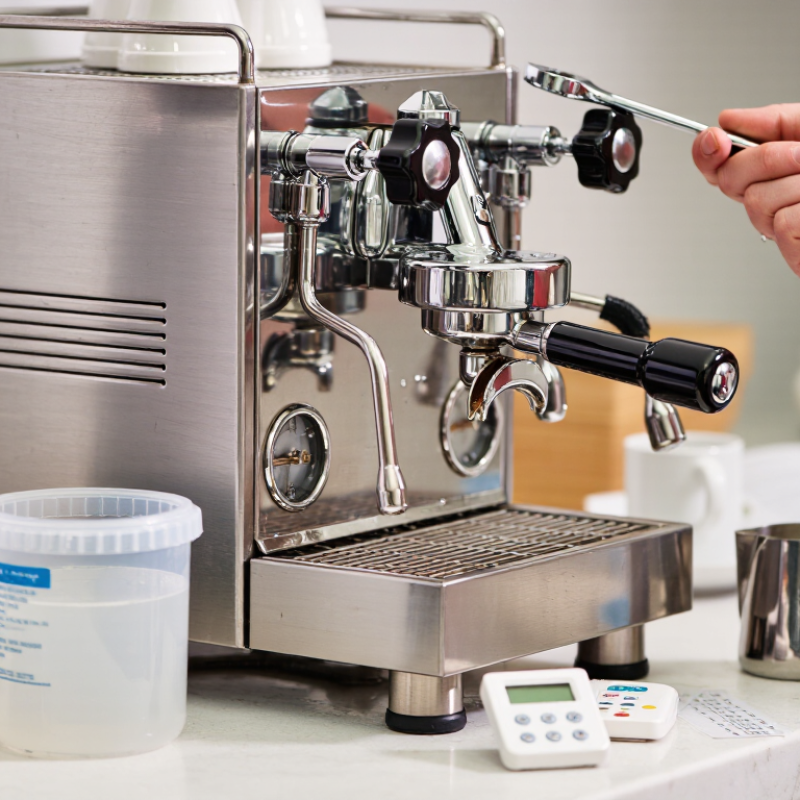
Professional espresso machines need more than a calendar-based descaling routine. Water hardness is a practical starting point, measured as ppm of calcium carbonate. SCA guidance commonly places hardness between 50 and 175 ppm. Within this range, water can support balanced extraction while limiting mineral buildup.
I check hardness with a fresh drop-test kit, not by guessing from taste. A 100 ppm reading may look harmless, yet a busy machine can still develop scale around the boiler probe, heating element, and narrow steam valve. Water above 175 ppm deserves closer attention, especially when the machine produces many shots daily. Scale often appears as a chalky ring inside the drain outlet. Flow may weaken before the problem becomes visible.
Water below 50 ppm is not automatically ideal. Very soft water can taste thin and may reduce useful buffering, while hardness alone cannot reveal alkalinity or corrosion risk. Test both hardness and alkalinity when possible. Keep the results beside your maintenance log.
Before descaling, confirm the procedure for the machine’s boiler and internal materials. Switch off power, allow the system to cool, and rinse thoroughly afterward. Acid strength, contact time, and incomplete rinsing can cause damage or leave unwanted residue. I have seen readings change after filter replacement, so one test should not become permanent truth. Test monthly in high-use cafés, and retest whenever the water source changes.
Before descaling a professional espresso machine, confirm the manufacturer’s stated interval. That interval may depend on water hardness, daily volume, and the machine’s internal design. A busy café using hard water may need service sooner than a low-volume bar. Check the current manual, service label, or authorized technical documentation. Do not rely on a generic calendar.
Use only a chemical approved for that exact machine or system. Different formulas may affect metal parts, seals, sensors, or internal coatings.
I once assumed a familiar household acid would be acceptable. It was not a safe assumption.
The machine manual should identify the chemical type, dosage, contact time, and required rinsing process. If the instruction is unclear, ask a qualified technician before adding anything.
Record the date and water conditions. Keep the product container available for verification. Before starting, remove coffee residue, empty the drip tray, and allow hot components to cool as directed.
Follow the stated dilution carefully; stronger is not better. It can leave residue or damage components. After descaling, run the required fresh-water cycles and check the water’s smell and taste.
A small amount of forgotten solution can spoil several shots. I also inspect the steam wand and outlet afterward, because missed deposits are easy to overlook. My log is not always perfect, but it often reveals a changing water problem.
2026 Top Guide: How to Descale a Professional Espresso Machine
Isolate the machine before touching the descaler. Switch it off, unplug it, and let the boiler cool completely. Close the water supply valve, then release pressure through the approved outlet. Remove the portafilter and drain the reservoir. This small pause prevents chemical contact and protects internal components. The USGS classifies water above 180 mg/L as calcium carbonate as very hard. In such water, chalky deposits can restrict valves, reduce flow, and create uneven heating. Inspect the group head, steam wand, and drain area for white flakes or weak discharge.
Prepare the descaler only at the concentration printed on its label. More chemical is not better. It may damage seals or leave residue. Less chemical may fail to dissolve scale. Mix it with the required water volume, then circulate it through the machine according to the service instructions. Do not leave the solution inside longer than directed. Flush repeatedly with clean water until there is no odor or unusual taste. Water quality guidance from the Water Quality Association links calcium and magnesium levels with scale formation, but local water can vary sharply. I have seen a machine look clean outside while its flow remained poor. That was a useful reminder: appearance is not proof.
Tips: Record the date, water hardness, solution ratio, and flush volume. Use test strips when possible. If pressure stays unstable, stop and request qualified service. A second inspection is worth the extra minute.
2026 Top Guide: How to Descale a Professional Espresso Machine
Descaling is incomplete until every trace of acidity leaves the machine. A professional machine may look clean, yet retain solution inside boilers, valves, and narrow passages. Follow the equipment manual for the approved descaler, dilution, heating time, and rinse volume. Wear suitable hand and eye protection. Keep a written record of the process.
Flush clean water through the brew group, hot-water outlet, and steam circuit. Open each path separately, not all at once. Collect the discharge in a clear container. Watch for foam, cloudiness, odor, or a sharp acidic taste. Clear water alone is not proof. Compare the rinse water with the incoming water, using pH strips only as an additional check. The readings should be close, not dramatically different.
Continue rinsing until the water smells neutral and shows no visible residue. Do not rush this step. Run several short cycles, allowing fresh water to replace trapped liquid inside the system. Purge the steam wand carefully, then wipe its tip before another flush.
Discard the first few water releases and test again. A clean-looking group head can still hide diluted descaler. I still check twice, because visual judgment is imperfect. Document the final readings, water volume, and any unusual odor. If acidity remains, stop using the machine and repeat the rinse according to the manual.
2026 Top Guide: How to Descale a Professional Espresso Machine
Scale forms when heated water leaves minerals inside boilers, valves, and narrow thermoblock channels. I have seen a clean group head produce weak flow after only a few months. The Specialty Coffee Association’s Water Quality Standard recommends pH 6–8, supporting balanced extraction and equipment protection. Its reference also places alkalinity near 40 ppm. For daily operation, many technicians target 40–75 ppm.
Test the water before descaling. Use a calibrated pH meter and an alkalinity test kit, not taste alone. Record the reading beside the machine’s service date. If flow slows, steam recovery changes, or the boiler sounds unusually sharp, isolate power and follow the manufacturer’s service procedure. Remove the reservoir, drain accessible water, and apply a suitable descaling solution at the stated concentration. Never guess the dosage. Rinse repeatedly until the discharge is clear and odor-free.
Prevention is more reliable than aggressive cleaning. The Water Quality Association explains that alkalinity influences buffering capacity, while mineral balance affects scaling behavior. Still, a pH reading can drift between tests. That part deserves humility. Water at 6–8 pH may still create deposits if heating cycles are heavy. Check alkalinity monthly, inspect the drain water, and review results after seasonal changes. Keep a simple log. Small records often reveal recurrence before the machine shows damage.
| Data Dimension | Recommended Value or Action | Why It Matters | Verification Method |
|---|---|---|---|
| Water pH | 6.0–8.0 | A balanced pH supports good extraction while limiting corrosion and mineral instability. | Calibrated pH meter or fresh laboratory-grade test strips. |
| Alkalinity | 40–75 ppm as calcium carbonate (CaCO3) | Provides buffering capacity and helps reduce sudden pH changes without excessive carbonate loading. | Drop-count titration kit reported as ppm CaCO3. |
| Descaling trigger | Visible scale, restricted flow, slow heating, unstable temperature, or abnormal noise | These symptoms can indicate mineral deposits in the boiler, heat exchanger, valves, or water paths. | Record flow rate, heat-up behavior, pressure, and visual condition during service. |
| Machine preparation | Switch off, unplug, allow the machine to cool, and isolate the water supply | Reduces the risk of burns, pressure release, electrical injury, and damage to components. | Confirm that the boiler pressure is at zero before opening or draining any circuit. |
| Descaling solution | Use only the concentration and contact time specified for the machine and descaler | Over-concentrated or incompatible acids may damage metals, seals, coatings, or internal components. | Follow the equipment service manual and the chemical safety data sheet. |
| Descaling sequence | Drain as directed, circulate or soak, flush thoroughly, then refill with treated water | A complete flush removes dissolved minerals and residual acid that could affect taste or components. | Check outlet water for clear appearance, normal odor, and near-neutral pH before operation. |
| Final rinse target | Rinse until discharge pH is close to the incoming water and no chemical odor remains | Residual descaler can produce off-flavors and accelerate corrosion. | Compare rinse-water pH with the source-water pH using the same test method. |
| Water hardness management | Use treatment that controls hardness while maintaining pH 6–8 and alkalinity 40–75 ppm | Hardness minerals, especially calcium, are the primary contributors to scale formation when heated. | Test hardness, alkalinity, pH, and conductivity after filter installation and replacement. |
| Filter maintenance | Replace or regenerate treatment media according to capacity, throughput, and test results | Exhausted media can allow hardness and alkalinity to rise, causing recurrence after descaling. | Maintain a log of installation date, water volume, test results, and replacement date. |
| Monitoring frequency | Test monthly at minimum; test weekly in high-volume or variable-water operations | Regular testing detects treatment failure before significant scale accumulates. | Use a written water-quality log and trend results over time. |
| Cleaning versus descaling | Backflush and clean coffee oils separately; descale only when mineral deposits require it | Detergents remove coffee residue, while acidic descalers dissolve mineral deposits; they are not interchangeable. | Use separate procedures, tools, and chemicals for each task. |
| Post-service checks | Confirm normal flow, pressure, temperature stability, steam performance, and taste | Performance checks help identify blocked passages, leaks, sensor issues, or incomplete rinsing. | Compare readings with the machine’s service specifications and document any deviation. |
| Professional service boundary | Use a qualified technician for boilers, heat exchangers, pressure systems, or persistent scale | Internal descaling can require disassembly, pressure testing, gasket replacement, and electrical checks. | Escalate when the manual requires internal access or when symptoms remain after flushing. |
A practical target is 50–175 ppm, measured as calcium carbonate. This range can support balanced extraction and limit mineral buildup.
Use a fresh drop-test kit. Do not rely on taste. Record the result beside the maintenance log.
Not immediately, but it deserves closer attention. Busy machines may develop scale around probes, heating elements, and narrow valves.
Look for a chalky ring near the drain outlet. Weakened flow may appear before visible scale.
No. It may taste thin and provide limited buffering. Hardness alone does not show alkalinity or corrosion risk.
Test monthly in a busy café. Retest after changing the water source or filter. One reading is not permanent truth.
Check the machine manual for materials, dilution, heating time, and rinse volume. Switch off power and let the system cool.
Flush each water path separately. Check for foam, cloudiness, odor, and sharp acidity. Clear water alone is not proof.
Run several short cycles with fresh water. Flush the brew group, hot-water outlet, and steam circuit separately.
Stop using the machine. Repeat the rinse according to the manual. Test again after discarding the first releases.
Descaling a professional espresso machine at home requires a careful, methodical approach rather than simply adding a cleaning solution and running a cycle. Start by assessing the machine’s scale risk against suitable water targets, especially hardness between 50 and 175 ppm. Then check the manufacturer’s instructions for the recommended descaling interval and approved chemical, since different systems may require different procedures. Before applying the solution, isolate the machine from normal operation and prepare the descaler at the exact concentration stated on its label.
If you are asking, “How to descale a professional espresso machine at home?”, the most important final step is thorough rinsing. Flush the machine repeatedly until all descaler residue, unusual taste, and acidity are gone. To reduce future buildup, use water within an SCA-oriented range, with pH of 6–8 and alkalinity of 40–75 ppm. Regular monitoring of water quality and timely maintenance can help preserve heating performance, brewing consistency, and the machine’s service life.

Invito Furniture